Greater Los Angeles
Serving patients throughout LA County including Beverly Hills, Santa Monica, Pasadena, and surrounding communities.

Aging composite bonding. Porcelain veneers that have gone bulky, opaque, or dark at the gumline. One crown or veneer on a front tooth that has never quite matched. Revision veneer treatment is the discipline of correcting existing dental work — and it is a different skill from starting on untouched teeth. This guide answers every question patients bring to Dr. Chirag Patel at Smiles by Dr. P in Beverly Hills about redoing dental work that no longer looks or feels right — for patients across Los Angeles, Orange County, and the Central Valley searching for revision veneers near them.
When a patient sits down in the consultation room at Smiles by Dr. P in Beverly Hills and says "I already had this done — I just don't like it," the clinical problem is fundamentally different from a first-time smile makeover. The tooth underneath is no longer a blank page. It may have been reduced, etched, bonded, stained by old cement, darkened by an aging core, or shaped to fit a restoration that was designed around someone else's plan.
That's why Dr. Chirag Patel treats revision veneers as their own category of care, with its own diagnostic sequence: understand what's actually under the existing work, understand why the previous result disappointed, and only then design the replacement. Skipping the middle step is the single most common reason a second attempt fails the same way the first one did.
This guide covers the three situations patients most often arrive with: revision after composite bonding, revision after previous porcelain work, and revision for a single-tooth mismatch — where one crown or veneer never blended with the teeth around it.
A consultation with Dr. Chirag Patel starts with a diagnosis of what you already have — photographs, imaging, and a candid assessment of your options before anything is touched.
Q. What are revision veneers?
Revision veneers are porcelain veneers designed and placed to replace or correct dental work that already exists. The term covers three broad situations: replacing aged composite bonding with porcelain, removing and remaking previous porcelain veneers or crowns, and adding or redoing restorations so that a single mismatched tooth blends with the teeth beside it.
What makes revision work its own discipline is the starting condition. A first-time veneer case begins with natural, untouched enamel. A revision case begins with an existing restoration, an altered tooth surface underneath it, and a bite that has already adapted to whatever shape was placed. The design decisions, the material selection, and the removal sequence are all different as a result.
At Smiles by Dr. P in Beverly Hills, Dr. Chirag Patel approaches every revision case as a diagnostic problem before it becomes an aesthetic one. Understanding why the previous result disappointed is what prevents the second result from disappointing the same way
Q. Why do veneers and bonding need to be redone in the first place?
Some reasons are simply the passage of time. Others are design or technique issues that were present from the day the work was delivered. The most common reasons patients seek revision are:
Material lifespan reached. Composite bonding typically looks its best for three to seven years. Porcelain veneers commonly last ten to twenty years. Nothing has gone wrong — the material has simply aged.
Staining and surface wear. Composite absorbs pigment from coffee, tea, red wine, and tobacco; its polished surface dulls over time. Porcelain does not stain, but the bonding cement at its margins can discolor.
Chips and fractures. Thin incisal edges, grinding, and nail-biting all take a toll on both materials.
Shade that no longer fits. Natural teeth darken slightly with age while bonded restorations do not — so a once-invisible restoration slowly becomes visible.
Bulky or over-contoured shape. Restorations built too thick look artificial, trap plaque, and irritate gum tissue.
Too opaque, too uniform, too white. The "Chiclet teeth" look — flat white, monochromatic, identical tooth shapes with no translucency or texture.
Dark or visible margins. Older crowns with metal substructures can create a gray line at the gumline, especially as gum tissue recedes.
Gum inflammation. Margins that sit too deep or contours that are too full keep tissue chronically irritated.
Debonding or recurrent decay. A veneer that has come loose more than once, or decay developing at a margin, requires removal rather than repair.
Bite and function problems. If the previous work was not designed around how the teeth actually meet, chipping and loosening tend to repeat until the bite is addressed.
Q. Does needing a revision mean my previous dentist did something wrong?
Usually not. The large majority of revision cases Dr. Chirag Patel sees in Beverly Hills fall into one of two categories, and neither implies poor treatment.
The first is age. Bonding and porcelain both have a service life. Work that lasted a decade did its job.
The second is a mismatch of aesthetic goals. Cosmetic dentistry is an artistic field with a wide range of styles. A very white, very uniform smile that reflected the preference of a previous decade may not be what the same patient wants today. That is a change in taste, not a failure of care.
A smaller group of cases does involve technical issues — over-reduced teeth, margins placed too deep, shade selected without proper communication with the laboratory, or a bite that was not evaluated. Even then, the useful conversation is about what to do next rather than assigning blame. Dr. Patel's role in a second-opinion consultation is to describe accurately what is present and what can be improved, not to criticize a colleague.
Q. Can old veneers actually be removed — and is the tooth underneath damaged?
Yes, existing veneers can be removed, and doing so safely is one of the defining technical skills of revision dentistry. Because porcelain is chemically bonded to the tooth, a veneer generally cannot be lifted off intact. It is sectioned and removed in a controlled sequence under magnification, with the goal of taking away restoration material while leaving tooth structure untouched.
The honest part of the answer: every removal carries some risk to the underlying tooth. Old bonding cement has to be distinguished from natural tooth structure, and the two can look similar. This is why removal is done slowly, under magnification, often with specialized burs and color-differentiating techniques — and why an unhurried appointment matters more here than in almost any other cosmetic procedure.
What patients find underneath varies. Teeth that had traditional veneers are already reduced, so the new restoration simply replaces the old volume. Teeth that carried composite bonding are frequently close to their original form, which occasionally allows a more conservative, minimal-prep replacement than expected.
Q. Is it awkward to get a second opinion on work done by another dentist?
It's one of the most common reasons patients come to Smiles by Dr. P, and there's nothing unusual about it. Seeking another perspective on significant elective treatment is ordinary and reasonable.
A second-opinion consultation with Dr. Chirag Patel is descriptive rather than adversarial. He will document what is present, explain in plain language what is contributing to your dissatisfaction, and outline the realistic paths forward — including the path where the honest recommendation is to leave the work alone.
Worth knowing: sometimes the recommendation after a revision consultation is not to redo anything. Selective polishing, a bite adjustment, gum treatment, whitening of the surrounding natural teeth, or replacing a single restoration rather than all of them can occasionally resolve the complaint at a fraction of the cost and tooth impact.
Dr. Chirag Patel evaluates what you have now — the material, the margins, the bite, the shade — and tells you plainly what a revision can and cannot change.
Most patients know something is off long before they can name it. These are the eight observations Dr. Chirag Patel hears most often at Smiles by Dr. P in Beverly Hills — each one points toward a specific clinical cause.
Sign 01 — A dark line has appeared at the gumline
Usually a metal substructure in an older crown becomes visible as tissue recedes, or a stained cement margin. Neither polishes away — both are corrected by replacing the restoration with an all-ceramic design.
Sign 02 — Your restorations look flat and uniformly white
A high-opacity ceramic or a monochromatic composite reflects light evenly instead of transmitting it. Natural enamel is layered and translucent at the edges. This is a material and layering issue, and it is one of the most reliably improvable.
Sign 03 — The bonding has gone yellow, gray, or blotchy at the edges
Composite absorbs pigment and its margins pick up stain over time. Repolishing helps briefly; once the discoloration is within the material, replacement is the durable answer.
Sign 04 — Your teeth feel bulky, or your lip catches on them
Over-contoured restorations were built out rather than shaped in. This affects speech, lip posture, and gum health — not just appearance — and is corrected through redesigned emergence profiles.
Sign 05 — One tooth stands out from all the others
The classic single-unit mismatch, most often a central incisor crown placed after trauma. Discussed in depth in its own section below — it is the hardest problem in cosmetic dentistry and the most satisfying to solve.
Sign 06 — Your gums stay red or bleed around certain teeth
Chronic localized inflammation around restored teeth usually reflects margin placement or contour, not brushing habits. Tissue health has to be resolved before new porcelain is designed.
Sign 07 — You've had the same veneer re-cemented more than once
Repeat debonding is a signal — typically a bonding-surface problem or a bite that loads that tooth excessively. Re-cementing again without addressing the cause tends to buy months, not years.
Sign 08 — Your smile no longer matches your face
Proportions that suited you at 28 can read differently at 45, and midline, edge position, and tooth display all shift with lip and facial change. This is a design question, and it is legitimate grounds for revision.
THE COMMON THREAD: Every one of these signs has a cause that can be identified before treatment begins. At Smiles by Dr. P, Dr. Chirag Patel's revision protocol is built around naming that cause first — because a redo that doesn't address the original cause is simply a more expensive version of the same result.
Bring photographs, old records, or nothing at all. Dr. Chirag Patel's revision consultations begin with diagnosis, and you'll leave understanding exactly what's driving the result you have.
Composite bonding is the most common starting point for revision cases. It is affordable, fast, and genuinely useful — and it is a material with a defined service life. Dr. Chirag Patel treats a steady volume of bonding-to-porcelain transitions at Smiles by Dr. P for patients across Beverly Hills and Greater Los Angeles.
Q. When should composite bonding be replaced with porcelain veneers?
Composite bonding is direct restorative resin, sculpted and cured on the tooth in a single visit. It typically performs well for three to seven years before staining, edge wear, and surface dulling become noticeable. Replacement with porcelain becomes the better option when:
The bonding has stained or discolored and no longer responds to polishing
Edges are chipping repeatedly, or you're returning for repairs more than once a year
Multiple front teeth are involved and matching new composite to old has become difficult
You want a result that holds its color and polish for a decade or longer
The bonding was used to mask deep discoloration that is now showing through
You are treating enough teeth that a unified, laboratory-designed smile makes more sense than tooth-by-tooth patching
Porcelain is not a universally superior material — it is a different one. Bonding is more conservative, more repairable, and considerably less expensive. Porcelain resists staining, holds a glass-like polish, and can be layered for translucency that composite cannot match at the incisal edge.
A useful frame: composite bonding is often the right answer for one or two teeth and a shorter horizon. Porcelain is usually the right answer for a coordinated front-tooth design meant to last ten to twenty years.
Q. Is going from bonding to veneers more invasive than starting fresh?
Often it is less invasive than patients expect — and this is one of the more encouraging facts in revision dentistry.
A great deal of composite bonding is additive. It was placed onto enamel that was lightly etched but not substantially reduced. When that composite is carefully removed, what remains underneath is frequently close to the original tooth, sometimes with much of the enamel intact.
That matters because enamel is the ideal bonding surface for porcelain. A tooth that still has its enamel shell can often receive a no-prep or minimal-prep veneer, which keeps the replacement conservative. Dr. Chirag Patel evaluates each tooth individually after removal rather than committing to a preparation depth in advance.
The exception is bonding that was placed over previously drilled tooth structure — old fillings, prior decay, or teeth that were reshaped before bonding. Those teeth start further along and generally need a conventional veneer preparation.
What this means in practice: the removal appointment doubles as a diagnostic appointment. Only once the composite is off can the final preparation design be confirmed — which is why Dr. Patel plans these cases with a range rather than a promise.
Q. Can I replace just the bonded teeth and leave the rest alone?
Sometimes — and it depends almost entirely on where the bonded teeth sit in your smile.
Bonding on a lateral incisor or a canine can often be replaced individually, because those teeth sit slightly back in the arch and catch light differently. Bonding on a central incisor is much harder to replace in isolation, because the two central incisors are directly compared to one another by every person who looks at you.
There is also a color problem. Porcelain holds its shade for the life of the restoration while natural teeth and older composite continue to change. A porcelain veneer matched perfectly to today's surrounding teeth will slowly become a slightly brighter tooth over the following years.
Dr. Chirag Patel typically discusses three scopes at the consultation: treating only the compromised teeth, treating the full "social six" (the teeth visible in a relaxed smile), or treating eight to ten upper teeth for a fully unified design. Each has a legitimate case, and cost, longevity, and how visible the transition zone will be all factor into the decision.
Q. Should I whiten before replacing my bonding?
Almost always, yes — and the order matters a great deal.
Whitening only lightens natural tooth structure. It has no effect on composite, porcelain, or any other restorative material. If you whiten after new veneers are bonded, the surrounding natural teeth will shift lighter and the new restorations will not follow.
The sequence Dr. Chirag Patel uses is: complete whitening first, allow the shade to stabilize for roughly two weeks, then select the final porcelain shade against the settled result. This way, the natural teeth and the new porcelain are matched at the color you actually intend to keep.
Sequencing rule: whiten, wait, then match. Whitening after bonding new porcelain cannot be corrected without replacing the porcelain.
Dr. Chirag Patel will map the sequence — whitening, removal, and design — so the transition is planned rather than discovered along the way.
Replacing existing porcelain is the most technically demanding form of revision. The teeth have already been prepared, the substrate may have darkened, and the removal itself has to be executed without borrowing further tooth structure. Dr. Chirag Patel treats these cases at Smiles by Dr. P for patients from Beverly Hills, across Greater Los Angeles, and from well outside California.
Q. When do existing porcelain veneers need to be replaced?
Porcelain veneers are replaced for clinical reasons, aesthetic reasons, or both. The clinical reasons are non-negotiable; the aesthetic ones are a matter of preference and timing.
Clinical reasons to replace:
Recurrent decay at a margin, where the seal between porcelain and tooth has been lost
A veneer that has debonded more than once
Fracture through the porcelain, which cannot be reliably repaired in the mouth
Chronic gum inflammation traced to margin placement or over-contouring
Open margins that are catching plaque and staining
Aesthetic reasons to replace:
Shade that reads too white, too gray, or too uniform against the face
Excessive opacity — the flat, light-blocking look with no translucency at the edges
Bulky contours or a "square block" tooth shape without individual character
Length, midline, or edge position that doesn't suit the lip line
A gray shadow at the gumline from an older metal-based crown alongside the veneers
Visible junctions where old restorations meet natural teeth that have since darkened
Timing note: aesthetic replacement is elective and can wait. Clinical replacement should not. If decay is developing under a veneer, delaying makes the eventual restoration larger and more invasive.
Q. How are old porcelain veneers removed safely?
Removal is a controlled, methodical procedure, not a matter of prying anything off. Bonded porcelain is mechanically and chemically locked to the tooth surface, so the restoration is taken down in layers.
Dr. Chirag Patel's removal sequence follows a consistent pattern:
Documentation first. Photographs, shade records, and impressions or digital scans of the existing work capture what is being replaced, including anything worth preserving in the new design.
Sectioning under magnification. The porcelain is cut through in defined channels with fine diamond instrumentation so the shell separates in pieces, rather than being levered against the tooth.
Distinguishing cement from teeth. This is the critical step. Residual bonding resin looks similar to enamel; magnification, tactile feedback, and staining techniques help ensure that what's removed is cement rather than tooth structure.
Assessing the substrate. The exposed tooth is evaluated for remaining enamel, decay, discoloration, and prior preparation depth. This assessment drives the material choice for the replacement.
Immediate provisionals. Temporary restorations are placed the same day, so you are never without front teeth.
Isolation systems such as a rubber dam or Isolite are used throughout to keep the field clean and dry, which protects both the removal process and the bond strength of what follows.
Q. My old veneers hid a dark tooth. Will the new ones still cover it?
Yes, but the way it's handled changes the design. A dark underlying tooth — from a root canal, an old metal post, internal staining, or years of bonding cement — is called the stump shade, and it is recorded as its own measurement, separate from the target shade of the finished smile.
Masking a dark substrate requires either more opacity in the ceramic or more thickness to work with. The practical consequence is a trade-off: the more light-blocking a restoration must be, the harder it is to build in the translucency that makes a tooth look real.
The techniques used to resolve this include a higher-opacity lithium disilicate core with layered feldspathic porcelain built over it, opaque resin cements, and occasionally internal bleaching of a single dark tooth before the veneer is designed — reducing the masking burden on the porcelain itself.
Why the stump shade is recorded: a laboratory that receives only the target shade and no substrate information is being asked to guess. Sending the stump shade with the case is a routine step, and it is one of the more common omissions behind a veneer that arrives looking gray, dull, or unexpectedly opaque.
Q. How do you fix veneers that look fake or "done"?
The artificial look almost always comes from four specific, correctable properties — not from porcelain as a material.
Uniform opacity. Real enamel transmits light, growing more translucent toward the biting edge. Veneers built from a single high-opacity ceramic reflect light flatly across the whole surface.
Identical shapes. Natural central incisors, laterals, and canines each have distinct proportions. Repeating one tooth shape across a smile is what produces the "Chiclet teeth" effect.
Missing surface texture. Natural teeth have subtle vertical ridges and micro-texture that break up reflected light. A perfectly smooth, glossy surface reads as manufactured.
Proportions that ignore the face. Width-to-length relationships, midline position, and how the edges follow the lower lip all determine whether a smile looks like it belongs to the person wearing it.
Correcting these is the core of the "not done" aesthetic Dr. Chirag Patel is known for at Smiles by Dr. P: custom opacity mapped per tooth, deliberate color variation from gumline to edge, golden-ratio proportions, and hand-built surface texture from a master ceramist.
The goal, stated plainly: a result that reads as your own teeth on their best day. Not whiter than a piano key, and not eight identical rectangles.
Q. My veneers keep chipping. Will new porcelain fix that?
New porcelain alone will not. Repeated chipping is a load problem, and porcelain of any quality will fail again if the forces that broke it are unchanged.
The evaluation looks at how the teeth meet in a closed bite, how the front teeth guide the jaw in side-to-side and forward movement, whether there is a grinding or clenching habit, and whether the previous restorations were made longer than the bite could accommodate.
Depending on findings, the plan may include adjusting the bite before new restorations are designed, changing the incisal edge position or length in the new design, selecting a higher-strength ceramic for the teeth taking the most load, addressing crowding or an edge-to-edge relationship o
Non-negotiable in revision work: if you grind, a night guard is part of the treatment plan, not an optional add-on. It is the least expensive component of the case and the one most responsible for how long the result lasts.
Q. Will replacing my veneers mean removing even more teeth?
In most cases, minimally. A tooth that already carries a veneer has already been reduced, so the new restoration is generally designed to occupy the same space the old one did. The goal is replacement of volume, not further reduction.
Some additional refinement is often needed — smoothing an irregular surface left by removal, refining a margin that was placed too deep or left short, or slightly adjusting a preparation that was over-tapered. These are small adjustments measured in fractions of a millimeter.
Where more significant reduction may be required is when a dark substrate needs greater masking thickness, when decay must be removed, or when the previous preparation left the tooth in a shape that cannot support a well-fitting restoration. If a tooth has lost enough structure that a veneer can no longer be supported predictably, Dr. Chirag Patel will say so and discuss a crown as the more appropriate restoration.
Bring it in. Dr. Chirag Patel will assess the margins, the substrate, the bite, and the design — then tell you what a second-generation result would realistically look like.
One front tooth that doesn't match the tooth beside it is, by broad agreement among cosmetic dentists, the most difficult result to achieve well. Dr. Chirag Patel takes on single-unit anterior matching cases at Smiles by Dr. P in Beverly Hills as a distinct category of work — because the tolerances are unlike anything else in dentistry.
Q. Why is matching a single front tooth so difficult?
Because the comparison is immediate and unforgiving. When ten teeth are restored together, the eye evaluates the smile as a whole and small variations read as natural. When one central incisor is restored, it sits directly beside its twin — and every person who looks at you compares the two without meaning to.
A natural tooth is not one color. It is a layered structure with a warmer, more saturated body near the gumline, a translucent zone at the biting edge that can appear gray or blue, internal characteristics such as white flecks and craze lines, subtle surface texture, and its own light-reflecting behavior. All of that has to be reproduced in ceramic, in the correct sequence, and then matched to a neighbor that will continue to change slowly over time.
This is why the single-unit central incisor is used as a benchmark of skill in cosmetic dentistry, and why these cases justify a longer, more collaborative process than a full-arch case does.
Q. I have one crown from an old injury that has never matched. What are my options?
This is one of the most common reasons patients seek revision care, and there are three legitimate paths. None is automatically correct — the right one depends on the condition of the neighboring teeth, the darkness of the underlying tooth, and how much change you want overall.
Option one — remake the single unit and match it to your natural teeth. The most conservative approach and the most technically demanding. Nothing is done to the adjacent teeth. Success depends on custom shade-taking, a master ceramist, and often a chairside try-in before the restoration is finalized.
Option two — treat both central incisors as a matched pair. Restoring the two centrals together means both are made from the same materials, by the same ceramist, at the same time. Symmetry between the two dominant teeth becomes far more predictable. The cost is that a healthy tooth is now restored.
Option three — extend to four or six front teeth. When the neighboring teeth also have aging bonding, wear, or shade you would like to change, treating the visible zone as one design removes the matching problem entirely and produces the most controlled result.
Dr. Chirag Patel presents all three at the consultation with the honest trade-offs attached: option one preserves the most natural tooth structure and carries the highest matching risk; option three carries the least matching risk and involves the most tooth structure. Option two sits between them and is chosen frequently for exactly that reason.
A candid note: a dentist who tells you a single dark, root-canal-treated central incisor can be matched with absolute certainty is overpromising. What can be promised is a rigorous process — custom shade records, stump shade, photographic communication with the laboratory, and a try-in stage before anything is permanently bonded.
Q. What does Dr. Patel do differently on a single-tooth match?
Single-unit anterior cases run on a protocol that a routine restoration does not require:
Custom shade session under controlled lighting. Shade is recorded with VITA guides plus calibrated photography, at a consistent time of day, against a neutral background — never under a colored operatory light or a lobby fixture.
Stump shade recorded separately. The color of the prepared tooth is documented independently of the target shade, so the ceramist knows what the porcelain has to mask.
Photographic mapping for the laboratory. High-resolution images with cross-polarized and standard lighting reveal internal characteristics — mamelon structure, incisal translucency, white spots, craze lines — that a written shade tab cannot convey.
Feldspathic layering where appropriate. For a single anterior unit, hand-layered feldspathic porcelain built up in increments by a master ceramist gives depth and translucency that a monolithic milled restoration typically cannot.
Bisque try-in before glaze. The restoration is evaluated in the mouth before final glazing, so the ceramist can adjust characterization while the porcelain can still be modified.
Try-in paste evaluation. Because cement shade affects the final appearance of a thin restoration, different cement shades are tested before the bond is made permanent.
This process takes longer than a routine case, and deliberately so. The additional appointments exist to remove guesswork from a result that is judged in a single glance.
Q. What if my mismatched tooth is an implant crown?
An implant crown adds two variables that a natural tooth does not have: the gum tissue architecture around the implant, and the color of the abutment showing through thin tissue.
Implant crowns often look different from natural teeth for reasons that have little to do with the porcelain — the gum contour may be flatter, the papillae between teeth may be shorter, or a metallic abutment may cast a gray tone through the tissue. Replacing the crown alone cannot resolve a tissue-level problem.
Dr. Chirag Patel evaluates implant mismatch cases with 3D imaging to understand what is achievable. The plan may involve a new crown with a ceramic abutment, soft-tissue contouring, or accepting a defined limit and improving the adjacent teeth so that the eye reads the smile as balanced overall.
Q. Why does the dental laboratory matter so much for a single tooth?
Because a single anterior unit is essentially a hand-made object. A full-arch case can be designed digitally and milled with excellent, repeatable results, since every unit is made from the same material and matches its neighbors by construction. A single tooth has to match something that already exists — and that is craft work.
Master ceramists build these restorations in layers, firing repeatedly, adjusting internal characterization between firings, and reproducing translucency and texture that milling alone cannot deliver. Some cases are best served by having the ceramist see the patient directly for a custom shade session.
Dr. Chirag Patel works with a curated network of master ceramists and matches the laboratory to the case rather than sending every restoration to the same bench. Single anterior units go to the ceramists whose strength is layered feldspathic work.
Single-unit matching is its own discipline. Dr. Chirag Patel will tell you honestly what level of match is achievable in your case — before you commit to anything.
A quick clinical reference for how different starting points are typically approached. Final candidacy and scope are always determined in person by Dr. Chirag Patel after examination and imaging.
| What you have now | Typical revision route | Outlook | Key consideration |
|---|---|---|---|
| Stained or chipped composite bonding on healthy enamel | Remove bonding, evaluate enamel, place minimal-prep or no-prep porcelain | ✓ Strong | Often more conservative than expected — enamel is frequently intact |
| Bonding placed over old fillings or previously drilled teeth | Remove bonding, conventional veneer preparation, layered porcelain | ✓ Strong | Substrate color must be recorded; masking may drive material choice |
| Aged porcelain veneers, sound margins, aesthetics only | Section and remove, refine preparation, second-generation layered porcelain | ✓ Strong | Usually replaces existing volume without further reduction |
| Veneers with dark or open margins, or gum inflammation | Resolve tissue health first, then remove and redesign margin placement | ✓ Strong | Tissue must be stable before final shade and contours are set |
| Repeatedly chipping or debonding veneers | Bite analysis first; redesign edge position, then replace with Night guard protocol | ~ Depends | Replacing porcelain without correcting the load repeats the failure |
| One mismatched crown or veneer on a front tooth | Single-unit remake, matched pair of centrals, or extend to four to six units | ~ Depends | Match difficulty rises sharply with substrate darkness |
| Mismatched implant crown in the front | 3D assessment; ceramic abutment, new crown, and possible tissue contouring | ~ Depends | Gum architecture may limit what a new crown alone can achieve |
| Veneers over teeth with significant structure loss or decay | Crowns or onlays rather than veneers; restorative treatment before cosmetics | ~ Different plan | A veneer needs supporting tooth structure to bond predictably |
| Untreated gum disease or active decay | Stabilize health first; cosmetic revision is deferred until resolved | X Not yet | New porcelain over unstable foundations is a short-lived repair |
| Severe crowding or a skeletal bite discrepancy | Orthodontics or bite therapy first; veneers afterward for refinement | X Not alone | Porcelain masking major misalignment requires aggressive reduction |
Legend:
✓ Strong — commonly a good revision candidate
~ Depends — case-specific evaluation required
✕ — another step comes first
A revision case runs longer than a first-time case, and the additional time is concentrated in diagnosis and try-in — the two stages that determine whether the second result is genuinely better than the first.
Step 01 — Diagnostic consultation
Clinical examination, full photographic series, digital scans, and CBCT or 3D imaging where indicated. Dr. Chirag Patel documents what exists, identifies the cause of your dissatisfaction, and reviews any records from the previous treatment you're able to provide.
Step 02 — Health and foundation phase
Gum inflammation, decay, and bite issues are addressed before cosmetic planning begins. If whitening of the surrounding natural teeth is part of the plan, it happens here so the shade can settle before matching.
Step 03 — Digital smile design and preview
Proportions, midline, edge position, and shade direction are designed against your facial features and lip dynamics — and you see a simulation of the intended result before any existing work is touched.
Step 04 — Removal and substrate assessment
Existing bonding or porcelain is removed under magnification with rubber dam or Isolite isolation. The exposed tooth is evaluated, the stump shade is recorded, and the final preparation design is confirmed based on what is actually found.
Step 05 — Provisional phase — the rehearsal
Temporaries are placed the same day, built to the approved design. You live in them, speak in them, and photograph them. Length, shape, and edge position are refined here — this stage is where a revision case earns its result.
Step 06 — Laboratory fabrication
The approved provisional design, shade records, stump shade, and photographic mapping are sent to the master ceramist matched to your case. Feldspathic layering, lithium disilicate, or zirconia is selected based on masking needs and load.
Step 07 — Try-in and approval
The finished restorations are tried in with water or try-in paste before any permanent bonding. Shade, contour, and translucency are evaluated in natural light with you holding a mirror. Adjustments go back to the ceramist if needed.
Step 08 — Bonding, occlusion, and aftercare
Final adhesive bonding under isolation, then bite refinement in every functional movement. A night guard is fabricated where grinding is a factor, and a follow-up visit confirms tissue health and comfort.
TYPICAL TIMELINE: Most revision cases at Smiles by Dr. P run two to four appointments across three to eight weeks, depending on whether whitening, gum treatment, bite therapy, or orthodontic alignment is needed first. Traveling patients from Antelope Valley, Orange County, the Central Valley, and out of state can have visits consolidated into extended appointment blocks — arranged in advance during planning.
Step one of every revision case is understanding what you already have. Dr. Chirag Patel's consultations are unhurried and commitment-free.
Q. Does a revision case cost more than the original work?
Usually somewhat more per tooth, and the reasons are specific rather than arbitrary.
Removal is a procedure in itself. Sectioning bonded porcelain under magnification takes clinical time that a first-time preparation does not require.
The substrate is more demanding. Darkened or previously prepared teeth often call for layered ceramics or additional laboratory stages to mask and characterize properly.
More laboratory involvement. Custom shade sessions, bisque try-ins, and hand-layered feldspathic work cost more at the bench than a single milled restoration.
More chair time overall. Additional try-in and refinement appointments are built into the plan deliberately.
In the Beverly Hills and Greater Los Angeles market, porcelain veneers commonly range from roughly $1,500 to $3,000 per tooth, with revision cases sitting toward the upper part of that range and complex single-unit anterior matching sometimes above it. Your actual fee depends on the number of teeth, the material selected, the laboratory, and any preparatory treatment required — and is quoted in writing after the diagnostic phase, never estimated over the phone.
Insurance reality: cosmetic revision is rarely covered. Where a restoration is being replaced for a clinical reason — decay under a margin, a fractured crown — some portion may be eligible. The practice can help you understand what to submit.
Q. What financing options are available?
Smiles by Dr. P works with several third-party healthcare financing partners, including CareCredit, Alphaeon, Lending Club, and Cherry. Terms, approval amounts, and promotional periods are set by the lender rather than the practice, and applications can generally be completed before your visit.
Many patients also phase revision treatment deliberately — resolving the clinically urgent teeth first and scheduling the elective aesthetic portion later. Dr. Chirag Patel will tell you which parts of your plan are time-sensitive and which can wait without consequence.
Q. How long will my revision veneers last?
Well-executed porcelain veneers commonly last ten to twenty years, and revision restorations are held to the same expectation when the underlying causes of the first failure have been addressed.
What actually determines longevity: the quality of the remaining tooth structure and the bond achieved to it, whether the bite was corrected and is protected by a night guard if you grind, gum health maintained through regular hygiene visits, and habits like nail-biting, opening packaging with your teeth, or chewing ice.
The honest caveat: a third revision on the same teeth is harder than a second. Each cycle costs some tooth structure. This is the strongest argument for taking the time to get the current revision right rather than choosing on the basis of speed or price.
Setting accurate expectations is part of the treatment. These are the situations where new porcelain alone is not the answer, and where Dr. Chirag Patel will recommend a different sequence — or recommend against treatment.
Limit 01 — Gum recession and lost papillae
Porcelain cannot regrow tissue. Where recession has exposed the root surface or the small triangles of gum between teeth have flattened, new restorations may hide part of the problem — but "black triangles" and root exposure are tissue conditions requiring periodontal or surgical assessment, not ceramic.
Limit 02 — Severe crowding or skeletal bite problems
Veneers can mask mild misalignment. Correcting significant rotation, crowding, or a skeletal discrepancy with porcelain alone requires removing far more tooth structure than is justifiable. Alignment first, refinement afterward, produces a more conservative and more stable result.
Limit 03 — Teeth that have lost too much structure
A veneer is a bonded restoration and needs sound tooth to bond to. Where repeated treatment has left a tooth substantially compromised, a crown or onlay is the appropriate restoration. Choosing a veneer for such a tooth is choosing a shorter service life.
Limit 04 — Facial volume change
Veneers restore tooth-driven support to the lower face — lip fullness that depends on tooth length and position. They do not reverse fat-pad volume loss or skin laxity. Where a concern is soft-tissue rather than dental, that distinction is drawn clearly at the consultation.
Limit 05 — Untreated grinding
If clenching or grinding is not managed, new porcelain will chip the way the last porcelain chipped. Bite therapy and a night guard are treatment components, not accessories, and Dr. Chirag Patel will decline to proceed without them where the evidence of parafunction is clear.
Limit 06 — Expectations no restoration can meet
Occasionally a patient arrives after several revisions, seeking a change that porcelain cannot deliver. The most useful thing a cosmetic dentist can do in that situation is say so plainly. Declining to operate is sometimes the correct clinical recommendation.
Dr. Chirag Patel would rather tell you a revision won't achieve what you're picturing than have you find out after treatment.
Patient: Female in her late 40s
Travel: Los Angeles. CA
Starting condition: The patient had several porcelain crowns on her upper front teeth from previous dental treatment. Over time, the crowns developed a dark line at the gumline. Because of this the crowns had developed noticeable differences in length, shape, and shade, creating an uneven appearance across her smile.
This usually happens when a metal substructure in an older crown becomes visible as tissue recedes, or a stained cement margin. Neither polishes away — both are corrected by replacing the restoration with an all-ceramic design.
Primary concern: She felt her front teeth looked mismatched, dark around the gumline and wanted a more balanced, natural-looking smile without creating an overly uniform or artificial appearance.
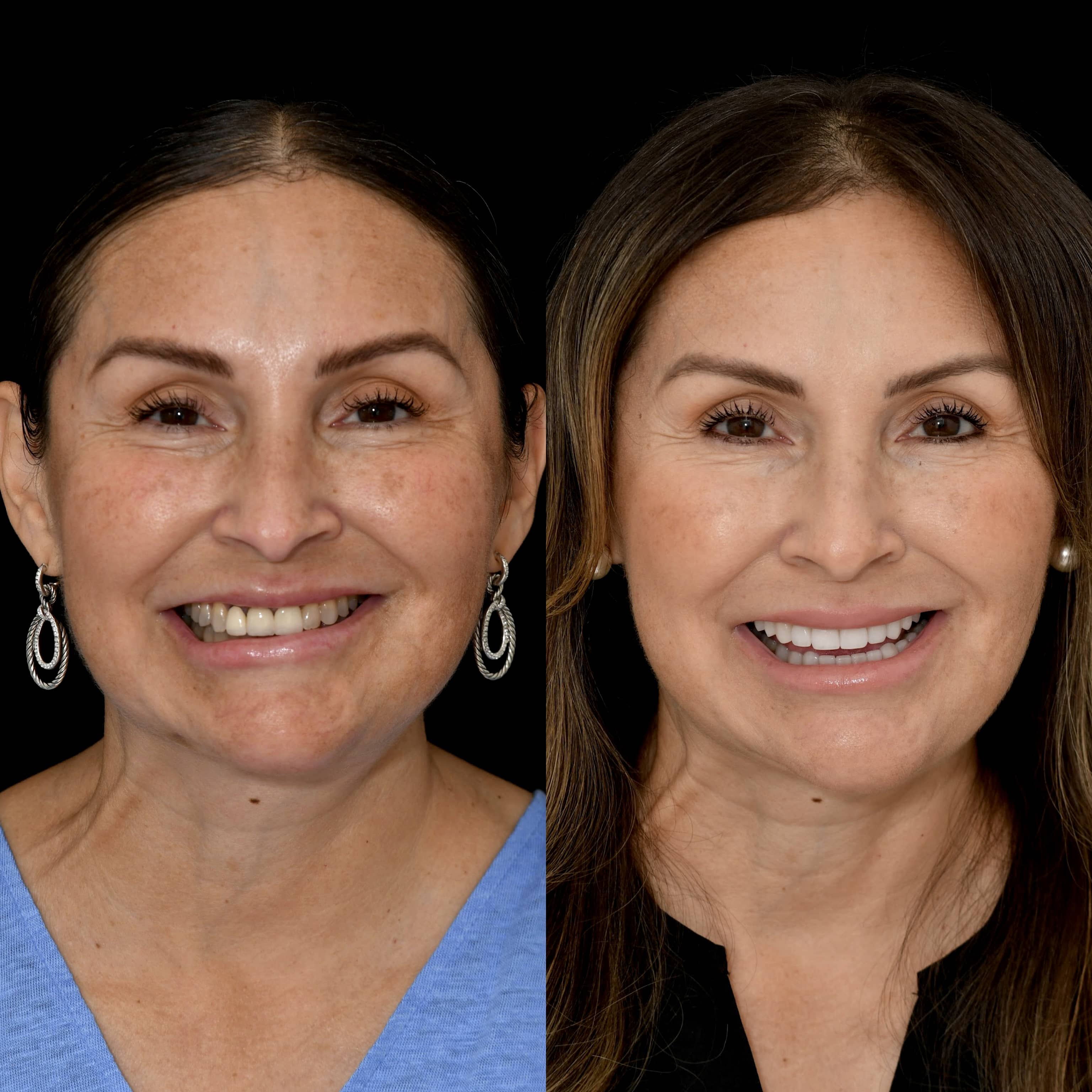
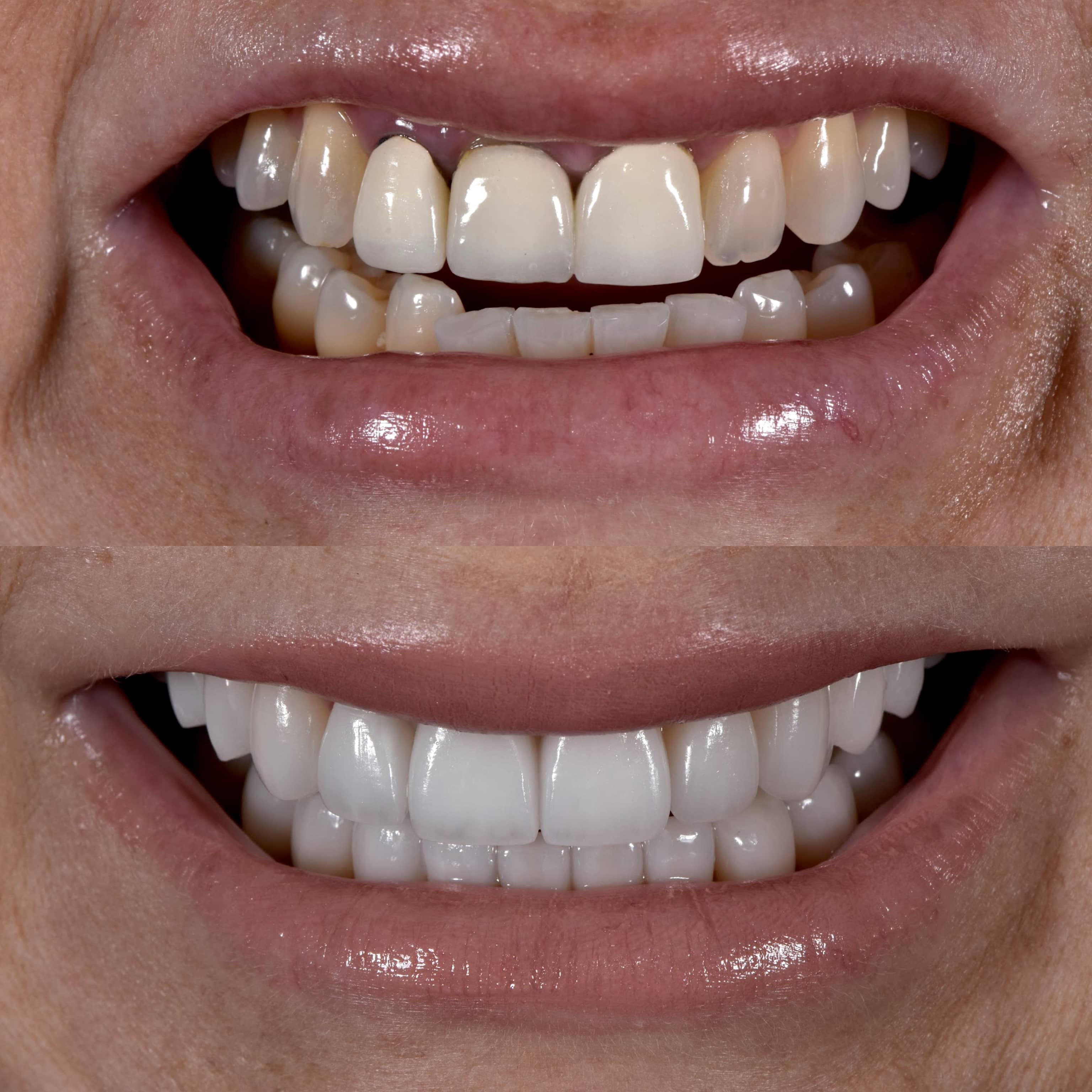
Dr. Patel's Treatment Approach: Dr. Patel evaluated the existing crowns, her bite, tooth proportions, and overall facial aesthetics before developing a new smile design. The uneven anterior crowns were carefully removed and replaced with custom-designed porcelain restorations. The most important philosophy in these cases is to create a healthy substructure under the new restorations after the old restorations are removed. Meticulous planning is done after using the most advanced diagnostic tools like 3D scanners, modern CT technology and advanced X rays. Each tooth was individually shaped and layered to create better symmetry while maintaining subtle variations in translucency and texture.
Outcome: The revised anterior restorations along with bite correction with posterior restorations created a more harmonious smile with improved symmetry, proportion, and color balance. Rather than making every tooth look identical, the new design was created to complement her facial features while maintaining a natural appearance.
"I knew my front teeth didn't look right, but I couldn't pinpoint what was bothering me. Once the crowns were redesigned, everything just looked balanced."
Patient: Female, in her late 30s
Travel: Los Angeles, CA
Starting condition: The patient had existing porcelain veneers but felt her restorations looked flat and uniformly white. She wanted them to have more depth and the characteristics of natural teeth. She was also unhappy with the cookie cutter shapes of her veneers and felts like the shapes of her existing veneers did not complement her face
Primary concern: She wanted veneers that looked more realistic rather than one solid, uniform color. She also wanted her veneers to complement her face and have more feminine shapes.
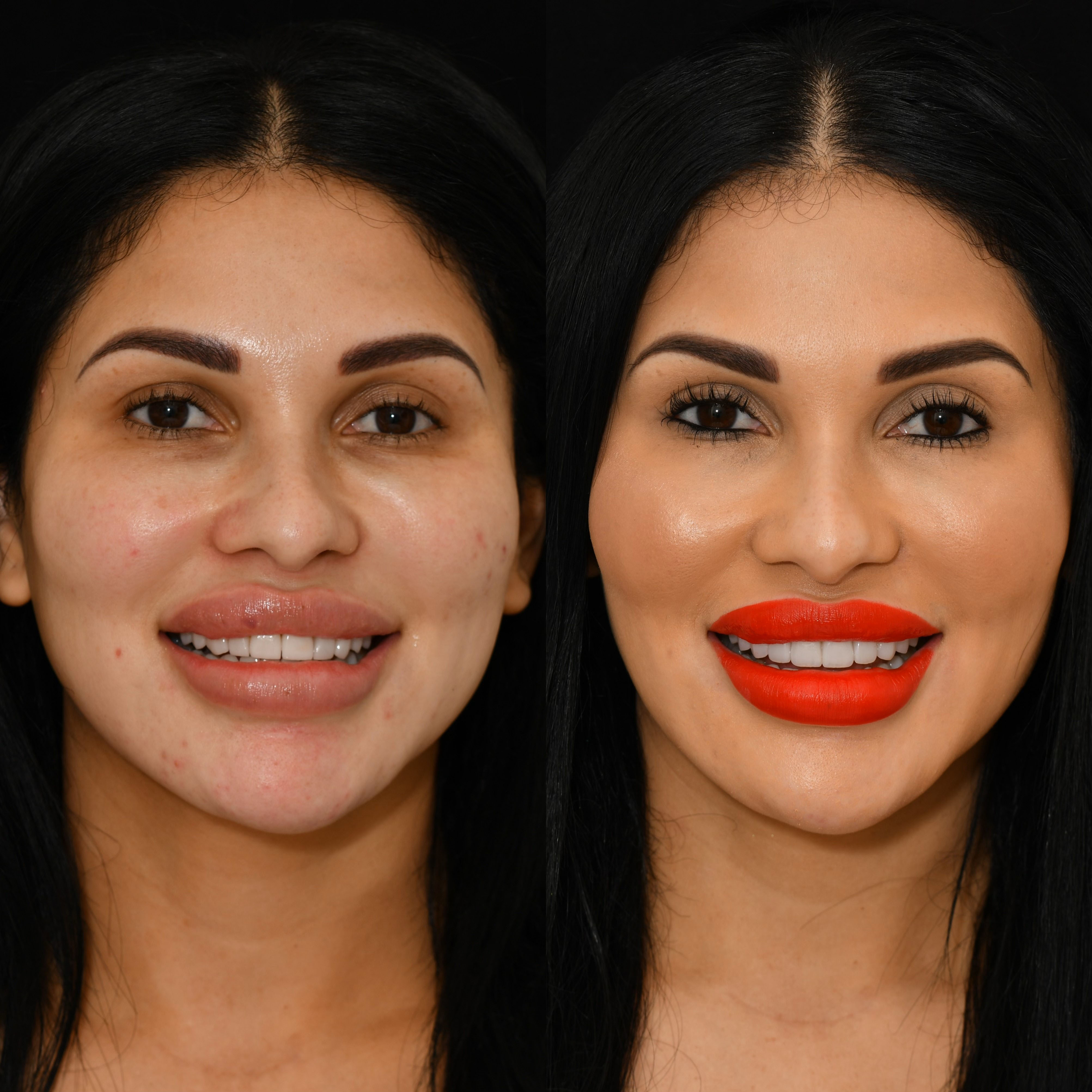
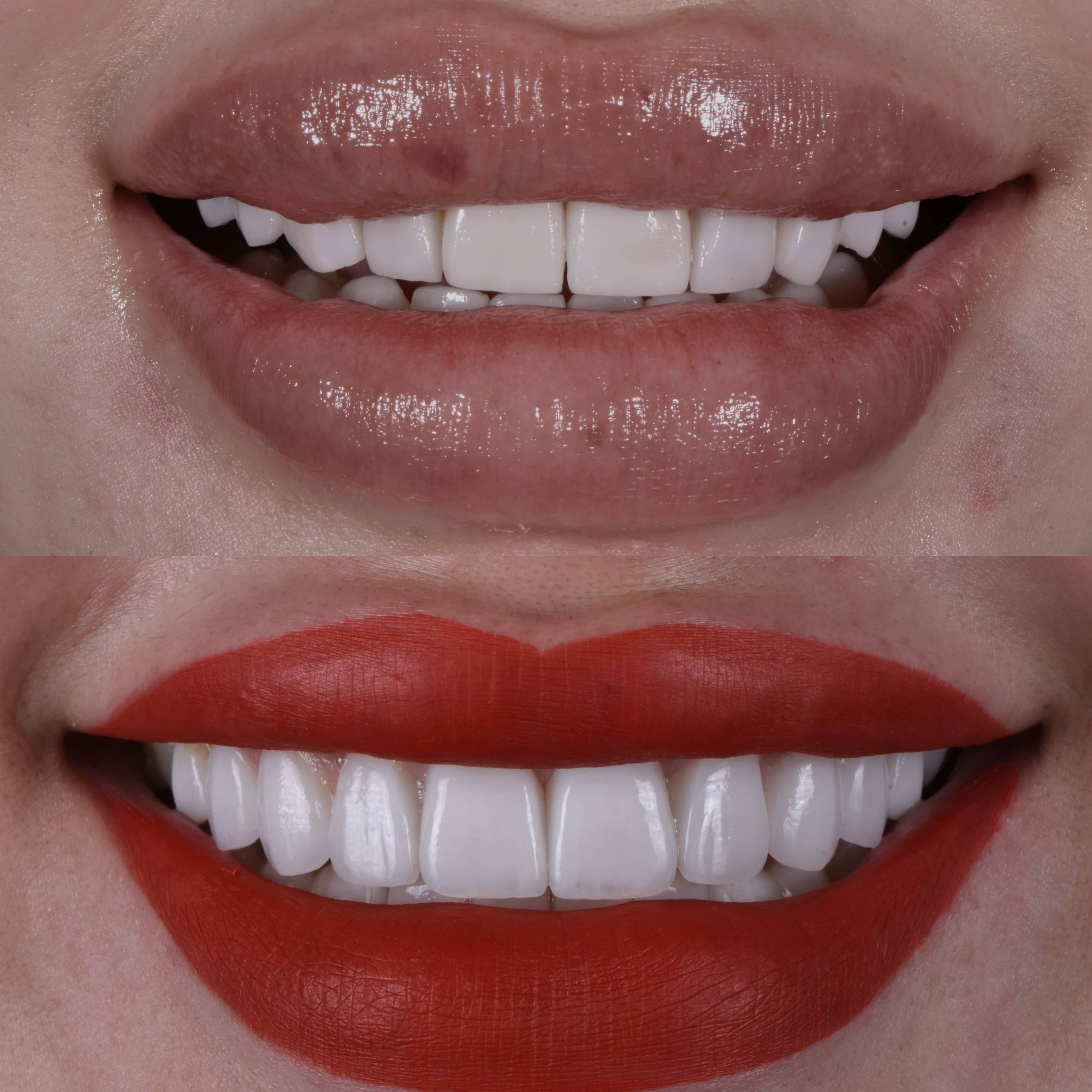
Dr. Patel's Treatment Approach: Dr. Patel explained that this can come down to meticulous planning taking into account face shapes and the material. It is very important to note that the results depend on how the porcelain is layered. High-opacity ceramic or monochromatic composite can reflect light evenly, while natural enamel has layers and becomes more translucent toward the edges. After evaluating her smile and aesthetic goals, Dr. Patel planned ten upper porcelain veneers for that corner to corner smile and to give support and lift to her lips. He redesigned her veneers using layered porcelain, natural surface texture, and controlled translucency to create more dimensional restorations.
Outcome: The new veneers followed her smile curve, had greater depth, light variation, texture, and translucency, creating a more natural-looking smile rather than a flat, uniform appearance.
“My new veneers finally have the depth and texture I was looking for—they actually look like real teeth.”
Patient: Female, in her early 20s
Travel: Los Angeles, CA
Starting condition: She had previously received porcelain veneers in Los Angeles but was unhappy with their overall shape and appearance.
Primary concern: She felt her veneers looked bulky making her lips feel incompetent. She wanted a smile that actually reflected her personal vision and looked more natural.
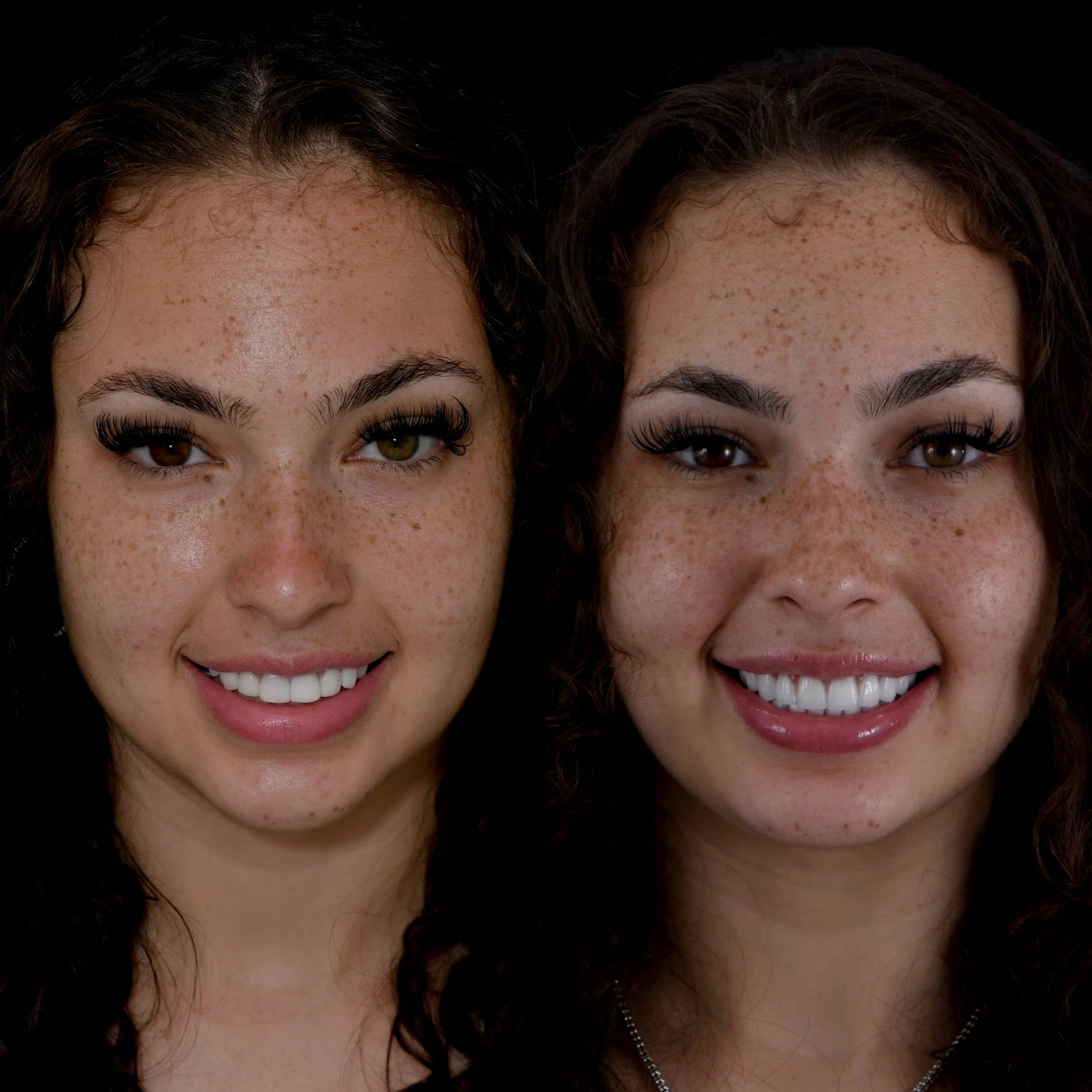
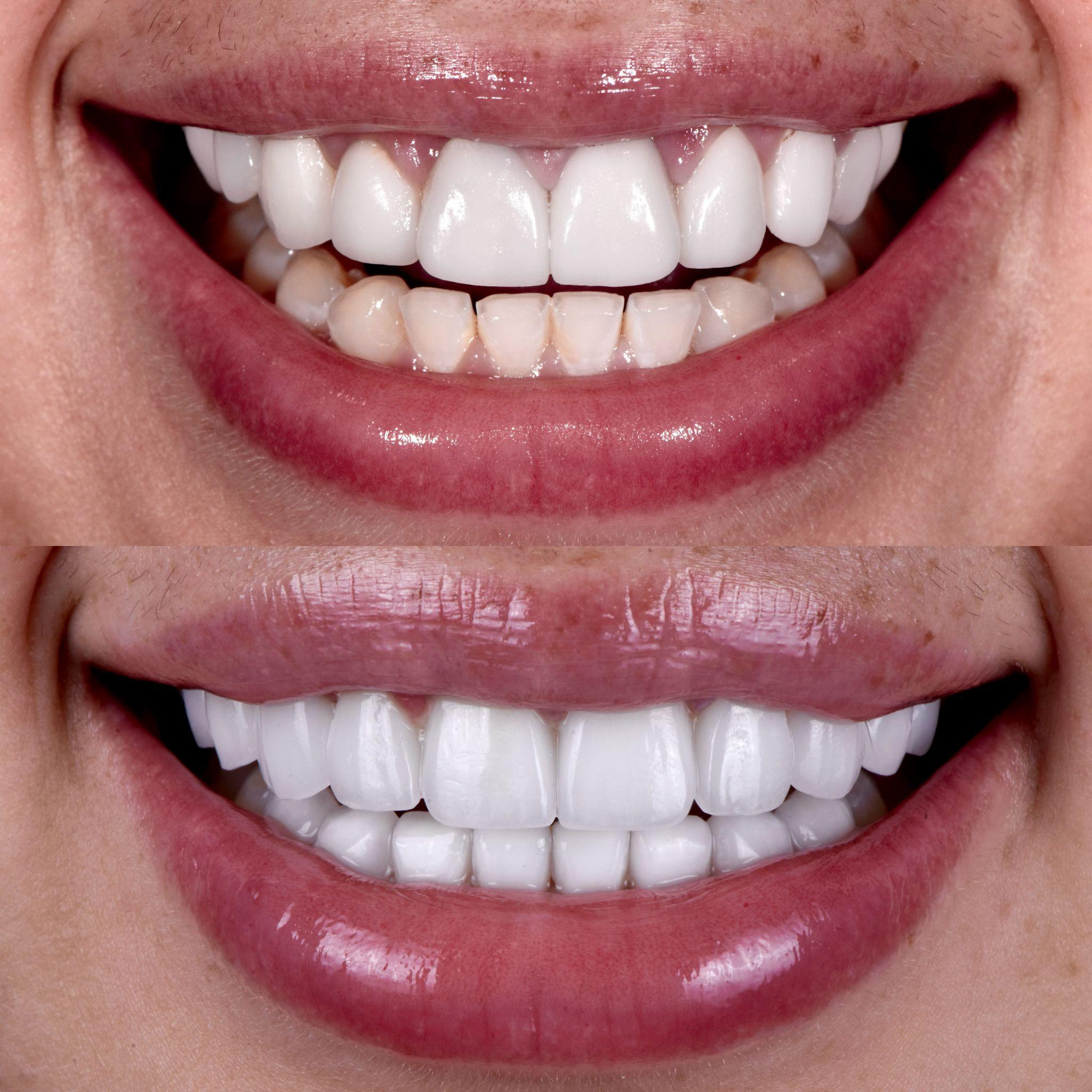
Dr. Patel's Treatment Approach: After carefully discussing what she liked and disliked about her previous veneers, Dr. Patel evaluated her smile and how the existing restorations affected her tooth position, lip posture, and overall facial balance. He noticed that the teeth appeared more protruded and felt bulky, with the restorations built outward rather than shaped to follow the natural contours of the teeth. Over-contouring can affect more than appearance—it can influence speech, how the lips rest around the teeth, and gum health. Dr. Patel redesigned both the upper and lower veneers with improved tooth shapes, proportions, and emergence profiles, creating a more natural transition from the teeth to the gums while incorporating realistic texture and translucency.
Outcome: A personalized veneer revision that better matched her vision while creating a more natural, dimensional smile.
"This time, I felt like Dr. Patel actually understood exactly what I wanted my smile to look like."
Patient: Female, 30s,
Travel:Los Angeles, California
Starting condition: The patient had a single anterior porcelain crown that noticeably mismatched the adjacent teeth in color, shape, and proportions. There was also slight misalignment that affected the overall symmetry of her smile.
Primary concern: She wanted her front teeth to look more uniform while keeping the result bright with natural characteristics.
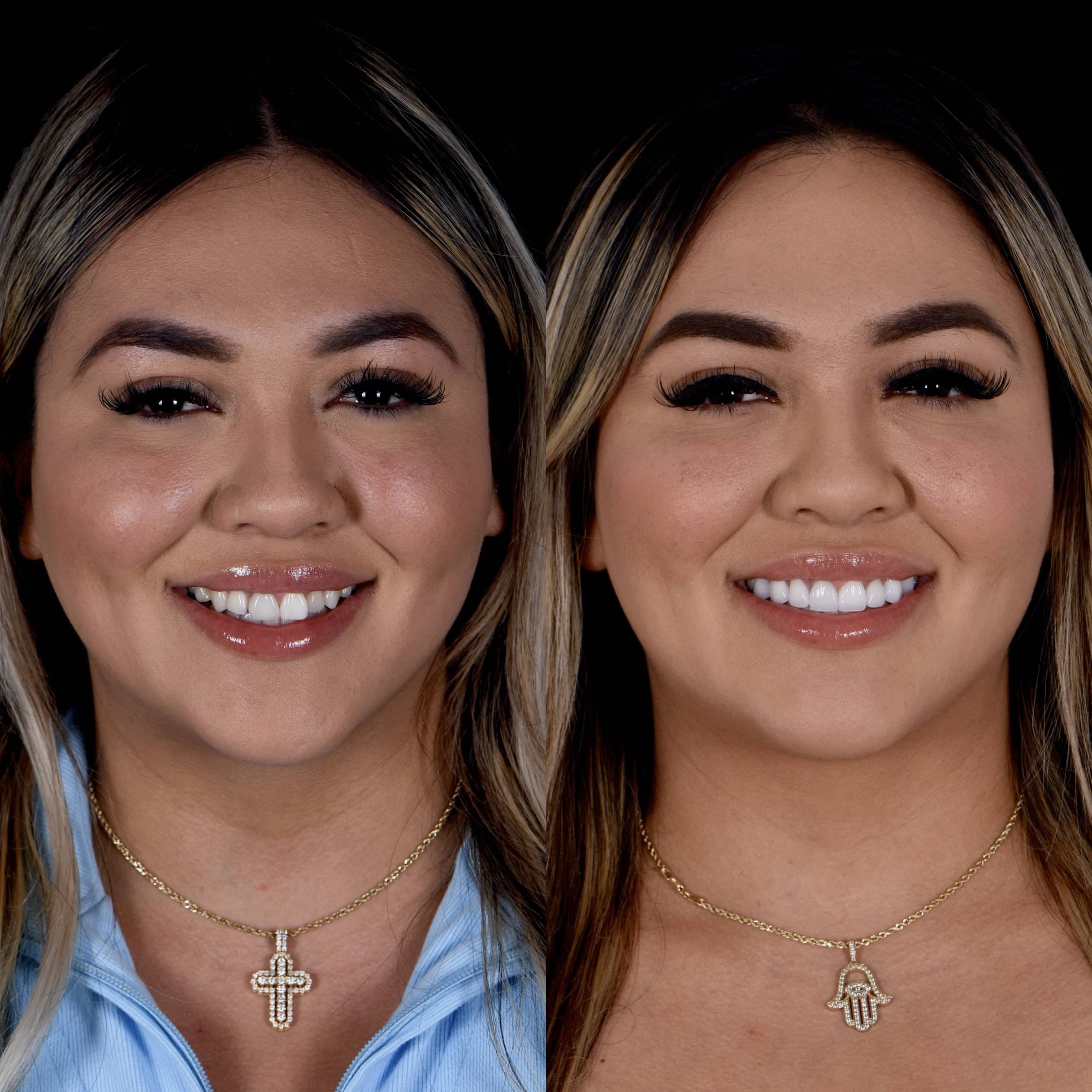
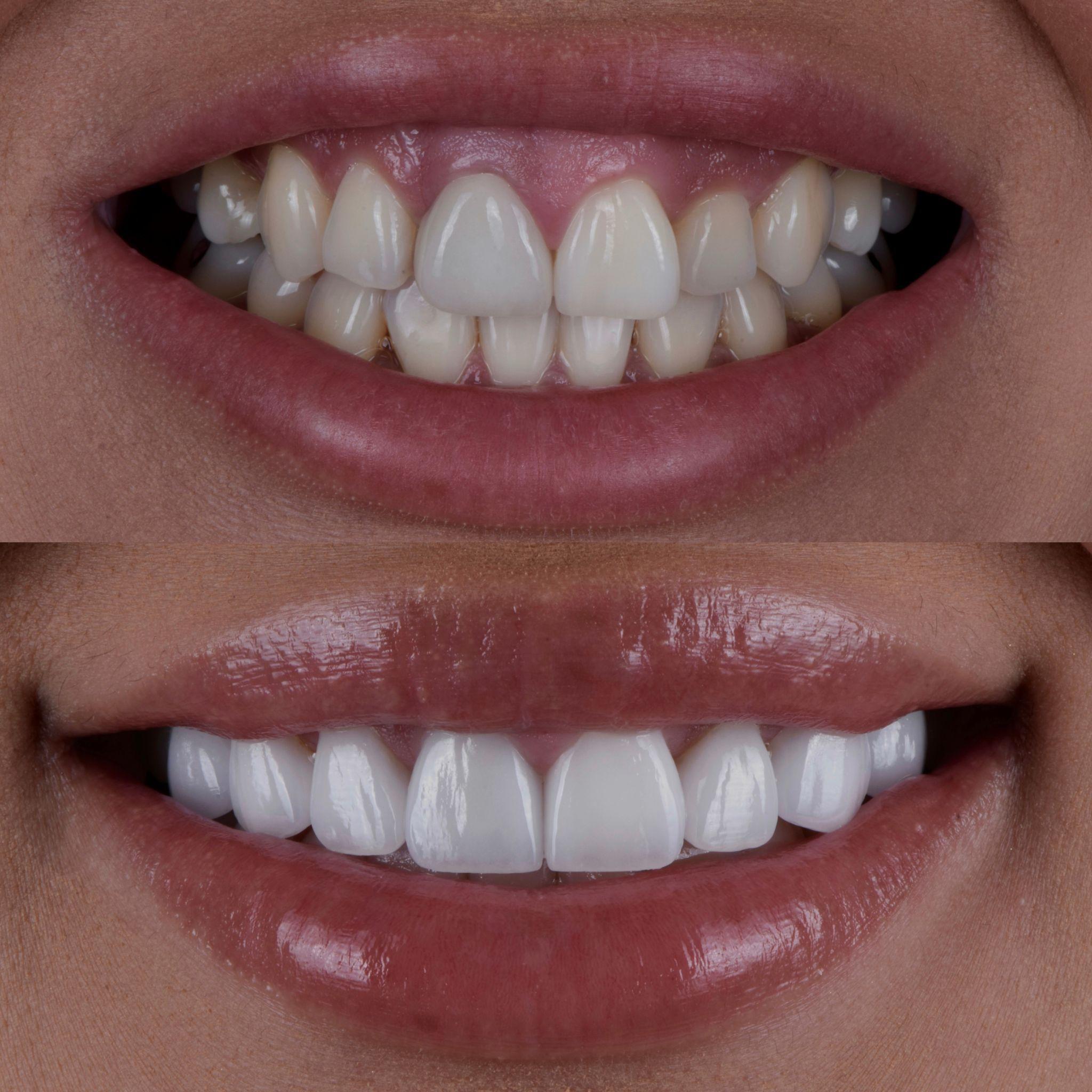
Dr. Patel's Treatment Approach: Dr. Patel carefully evaluated the existing anterior crown and compared it to the surrounding teeth, looking at the shade, shape, proportions, and overall balance of the smile. Because the single crown stood out from the rest of her teeth, he focused on creating a better color match based on the shade she wanted while also addressing the minor misalignment of the surrounding teeth. The custom 7 porcelain veneers were designed along with matching the front crown for the anterior teeth with natural texture, translucency, and subtle variations in shape so the crown and veneers would blend together seamlessly rather than looking like separate restorations.
Outcome: The smile became more balanced and uniform, with top 7 veneers and 1 crown combination, blending naturally with the surrounding teeth rather than looking overly perfect or artificial. When a patient chooses a very bright color for porcelain restorations, natural characteristics like texture and translucency make them look more realistic and life-like rather than flat white.
Patient: Female,in her 30s
Travel: Los Angeles, CA
Starting condition: The patient had composite bonding that had discolored and chipped over time, creating a noticeable difference in color and making her smile look less uniform.
Primary concern: She wanted to replace the stained bonding with a brighter, longer-lasting, and more natural-looking solution.
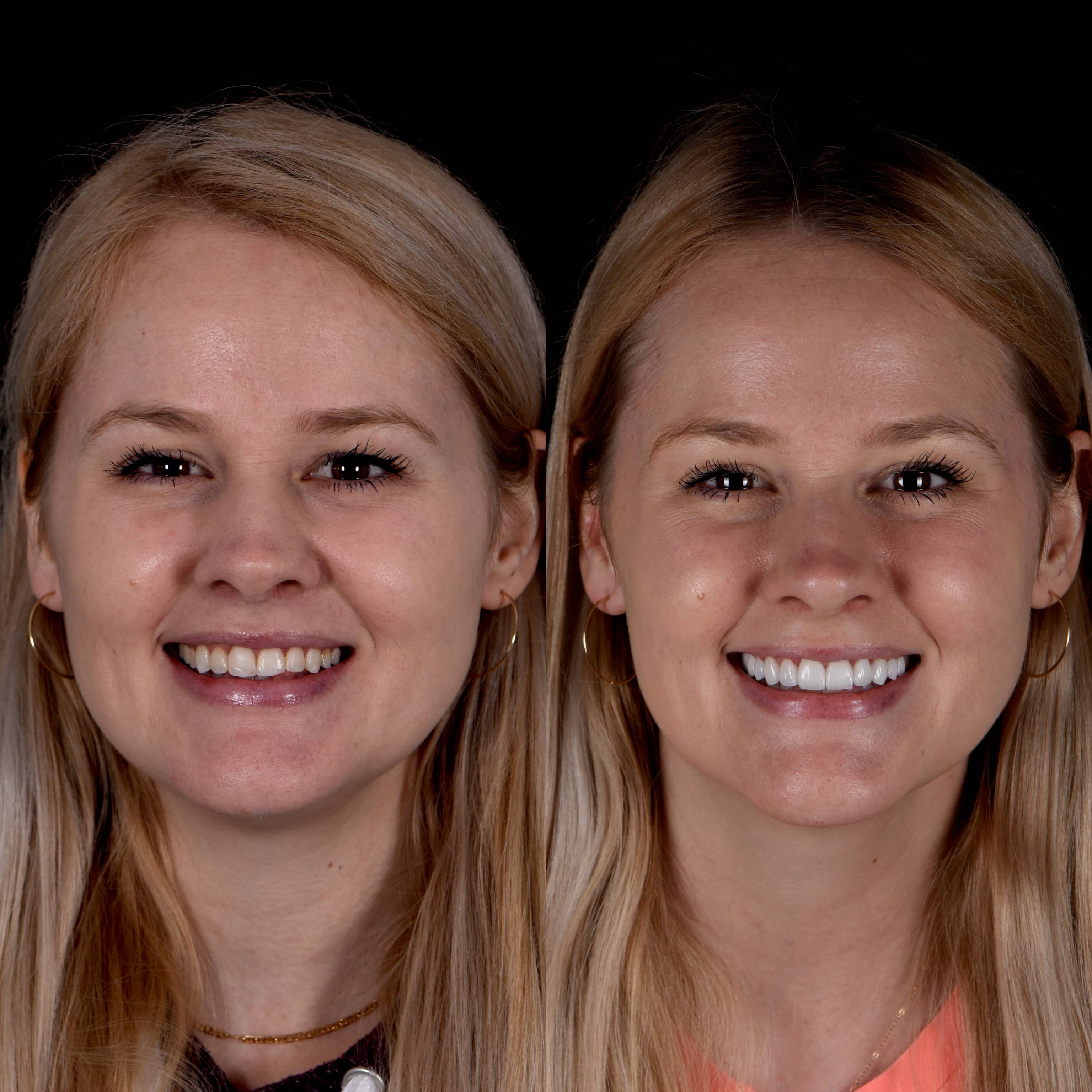
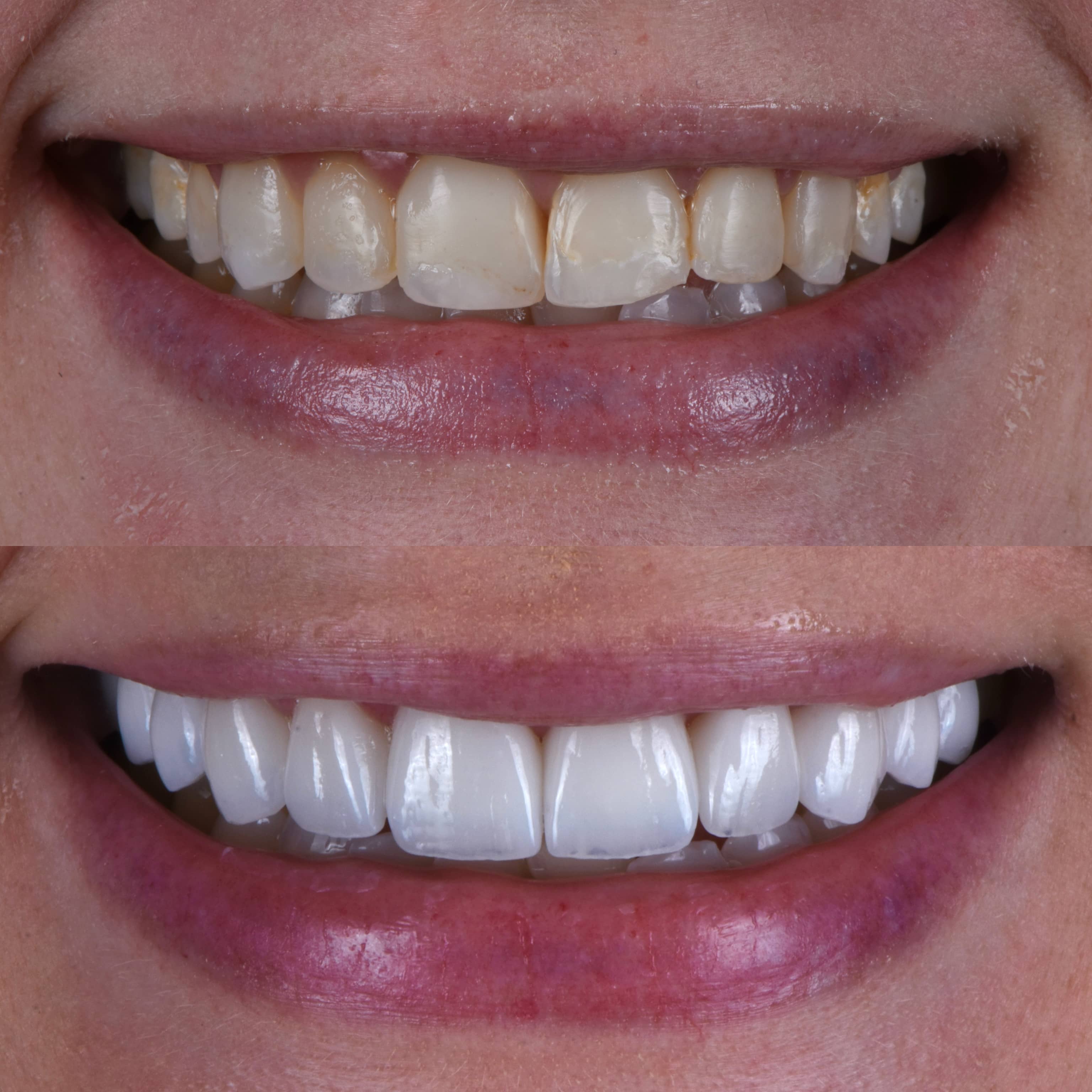
Dr. Patel's Treatment Approach: Dr. Patel's treatment: Dr. Patel carefully evaluated the existing composite bonding and the health of the teeth underneath before removing it. Over time, composite can absorb pigments, and the margins can pick up stains, which is why the bonding has become yellow and blotchy around the edges. While repolishing can help temporarily, once the discoloration has absorbed into the material, replacing it is the more durable solution. Dr. Patel planned custom porcelain veneers for the upper 10 teeth with more than just color in mind—he also focused on improving the shape, proportions, and symmetry of her smile while keeping the result natural. Porcelain veneers are highly stain-resistant, so it helps maintain a more consistent color over time compared with composite bonding. They are also much more durable and stronger than composite veneers with more documented longevity. The veneers were designed with a natural shade, subtle texture, and translucency for a seamless, lifelike finish.
Outcome: A brighter, more uniform smile with natural-looking porcelain veneers designed to provide greater color stability than her previous composite bonding.
Every revision Dr. Chirag Patel plans begins with a thorough diagnostic consultation and a digital preview. You'll know what's realistic before any commitment.
Revision cases are referred and self-selected differently from first-time cases. Patients arriving at Smiles by Dr. P have usually already been through the process once and are choosing on the basis of judgment rather than novelty.
01 — Volume of second-time cases
With more than 25,000 veneers placed across 14+ years, a substantial share of Dr. Chirag Patel's practice is revision work. Removal technique, substrate assessment, and single-unit matching are routine here rather than occasional.
02 — Diagnosis before design
Every revision consultation identifies why the previous result disappointed before any new plan is proposed. Skipping that step is the most common reason a second attempt repeats the first.
03 — Conservative removal protocol
Sectioning under magnification, isolation with rubber dam or Isolite, and careful differentiation of cement from enamel. The governing principle is that tooth structure is finite and the patient may need a third restoration one day.
04 — Master ceramist network
The laboratory is matched to the case. Single anterior units go to ceramists whose strength is hand-layered feldspathic work; full-arch cases go where consistency and turnaround serve the design better.
05 — The "not done" aesthetic
Custom opacity, subtle color variation, golden-ratio proportions, and real surface texture — the technical vocabulary behind results that read as natural teeth rather than dental work. Most revision patients arrive asking for exactly this.
06 — Straightforward about limits
Some cases are better served by treating fewer teeth, by a different specialty first, or by leaving the existing work alone. Patients considering a second round of treatment deserve to hear that plainly.
Most patients begin this process by searching for "redo veneers near me" or "revision veneers near me." Here is what those searches don't tell you, and how distance actually works for a revision case at Smiles by Dr. P in Beverly Hills.
Q. Where can I get revision veneers near me in Los Angeles or Orange County?
Smiles by Dr. P is located at 435 N Roxbury Dr., Ste 410, Beverly Hills, CA 90210 — on North Roxbury Drive in the
Beverly Hills medical corridor, a short walk from the Golden Triangle. Dr. Chirag Patel sees revision veneer patients from across Los Angeles County and Orange County, including Beverly Hills, West Hollywood, Santa Monica, Brentwood, Pasadena, Newport Beach, Irvine, and Huntington Beach.
Typical drive times to the Beverly Hills office, traffic depending:
Beverly Hills and the Westside — under 15 minutes
Downtown and Central Los Angeles — roughly 25 to 40 minutes
Pasadena and the San Gabriel Valley — roughly 40 to 60 minutes
Huntington Beach — roughly 45 miles, about one hour
Newport Beach and Irvine — roughly 48 to 55 miles, about one hour to 90 minutes
Lancaster and Palmdale — roughly 60 to 70 miles, about 70 to 90 minutes
Bakersfield — roughly 110 miles, about two hours
Visalia and Fresno — roughly 185 to 220 miles, about three to four hours
Worth knowing: revision cases are not high-frequency appointments. Most run two to four visits total, so a one-hour drive from Orange County usually means a handful of trips across the entire treatment, not a weekly commitment.
Q. What should I look for when searching "redo veneers near me"?
Proximity is the wrong first filter for a revision case. The teeth have already been treated once, and each additional cycle costs some tooth structure — so technique matters more than mileage.
Questions worth asking any practice you're considering, in Los Angeles or anywhere else:
How many revision cases do you treat? Removal of bonded porcelain is a different skill from placing a first-time veneer.
How will you remove my existing work? The answer should involve sectioning under magnification and isolation, not leverage.
Will you record my stump shade? If a practice doesn't record the color of the tooth under the restoration, the laboratory is guessing.
Which laboratory will make these, and why that one? Single anterior units need a master ceramist who hand-layers feldspathic porcelain.
Will I see a try-in before anything is permanently bonded? A revision case without a try-in stage is a gamble.
What caused my first result to disappoint? A practice that can't answer this before proposing a plan is likely to repeat it.
The practical test: if a nearby practice can answer all six well, distance is a real advantage. If it can't, a longer drive two or three times is the cheaper decision over a ten- to twenty-year horizon.
Q. I live in Fresno or the Central Valley. How does treatment work at that distance?
Patients travel to Beverly Hills from Fresno, Bakersfield, Visalia, and throughout the Central Valley regularly, and the schedule is built around the drive rather than in spite of it.
A typical long-distance revision plan looks like this:
Virtual consultation first. Photographs and a video call let Dr. Chirag Patel form an initial assessment before you drive anywhere.
Consolidated first visit. Examination, imaging, records, digital smile design, and — where clinically appropriate — removal and provisionals in the same extended block.
Provisional period at home. You wear the temporaries in your normal life while the laboratory work is underway, and send photographs for feedback.
Consolidated delivery visit. Try-in, adjustment, bonding, and bite refinement in one appointment block.
Most Central Valley revision patients complete treatment in two to three trips. Appointment blocks are reserved in advance, and scheduling is coordinated around a single overnight stay where that's easier than a same-day return.
Q. Why do Orange County patients drive to Beverly Hills to have veneers redone?
Orange County has excellent cosmetic dentistry. The reason revision patients from Newport Beach, Irvine, and Huntington Beach make the drive up the 405 is narrower than general quality: revision volume.
Removing bonded porcelain without damaging the tooth beneath, reading a darkened substrate, and matching a single anterior unit to its natural neighbor are skills built through repetition. With more than 25,000 veneers placed over 14+ years and a substantial share of that being second-time-around work, those procedures are routine at Smiles by Dr. P rather than occasional.
A second consideration is that many Orange County patients seeking revision have already had one redo attempt. At that point, the value of getting the next attempt right outweighs the convenience of a shorter drive.
Q. How many visits to Beverly Hills will my revision take?
Most revision cases run two to four appointments across three to eight weeks. The count depends on whether whitening, gum treatment, bite therapy, or orthodontic alignment is needed before the cosmetic phase, and on whether your case involves a single-unit match — which adds a try-in appointment by design.
For patients driving from Orange County, the Antelope Valley, or the Central Valley, appointments are combined into longer blocks wherever it is clinically safe to do so. Dr. Chirag Patel will give you the visit count and the schedule shape at the consultation, before you commit to treatment.
Start with a consultation at Smiles by Dr. P in Beverly Hills — or a virtual consultation first if you're driving in from Orange County, the Antelope Valley, or the Central Valley.
At Smiles by Dr. P in Beverly Hills, Dr. Chirag Patel treats revision veneer patients from across California. The office is at 435 N Roxbury Dr., Ste 410, Beverly Hills, CA 90210 — in the North Roxbury Drive medical corridor beside the Golden Triangle, minutes from Wilshire Boulevard and readily reached from the 405, the 10, and the 101.
Beverly Hills, CA 90210
Home office · Under 15 minutes from the Westside
Our home city. Beverly Hills patients often arrive with high-quality veneers from a decade ago that no longer suit their face, or with a single restoration that has aged differently from its neighbors. Walk-in-distance for the Golden Triangle, Beverly Grove, and the Wilshire corridor.
Los Angeles & the Westside
15–45 minutes · Santa Monica, WeHo, Brentwood, Culver City, Pasadena
Greater Los Angeles supplies the widest range of revision cases — aging composite bonding, "Chiclet" porcelain from an earlier aesthetic era, and second opinions on work completed elsewhere in the city. Evening-adjacent and consolidated appointments help patients working in Century City, Downtown LA, and the studios.
Newport Beach
≈50 miles · About 1 hour to 90 minutes via the 405
Newport Beach patients frequently come for single-tooth matching and for second-generation veneer design after a first set that reads too bright or too uniform. Appointments are grouped into longer blocks so the round trip is made as few times as possible.
Huntington Beach
≈45 miles · About 1 hour via the 405
Bonding-to-porcelain transitions are the most common Huntington Beach request — years of composite on the front teeth that has stained, chipped, and been repaired more than once. Virtual consultations are available before the first drive.
Irvine
≈50 miles · About 1 hour to 90 minutes via the 405 or 5
Irvine patients often arrive researched and specific — asking about stump shade, feldspathic layering, and removal protocol by name. Consultations are built for that: diagnosis first, materials and sequencing explained in full, quote in writing afterward.
Fresno
≈220 miles · About 3.5–4 hours via the 99 and 5
Fresno revision patients typically complete treatment in two to three trips, beginning with a virtual consultation and photographs. Extended appointment blocks combine records, removal, and provisionals — then try-in and bonding on the return visit.
Central Valley
Bakersfield ≈2 hrs · Visalia ≈3 hrs · Modesto & beyond
Bakersfield, Visalia, Hanford, Tulare, Modesto, and surrounding Central Valley communities. Travel-friendly scheduling, consolidated visits, and photograph-based check-ins during the provisional phase reduce the number of drives required.
Antelope Valley
Lancaster & Palmdale ≈60–70 miles · About 70–90 minutes
Lancaster, Palmdale, Quartz Hill, and the surrounding high desert. A long-standing patient base at Smiles by Dr. P, with appointment blocks scheduled to avoid peak traffic on the 14 in both directions.
Out of State & International
Virtual consultation first · Coordinated treatment blocks
Second-opinion and revision patients travel to Beverly Hills from other states and from abroad. Treatment is sequenced around flights, with virtual planning in advance and provisional check-ins by photograph between visits.
GETTING HERE: Smiles by Dr. P · 435 N Roxbury Dr., Ste 410, Beverly Hills, CA 90210 · (323) 909-9300. The office sits in the Beverly Hills medical corridor on North Roxbury Drive, north of Wilshire Boulevard and a short walk from the Golden Triangle shopping district. Arrival and parking details are sent with every appointment confirmation. Virtual consultations are available for patients in Orange County, the Central Valley, and beyond.
Smiles by Dr. P
435 N Roxbury Dr., Ste 410
Beverly Hills, CA 90210
Phone:(323) 909-9300
Dr. Chirag Patel's revision consultations are unhurried, diagnostic, and commitment-free. You'll leave understanding what's driving the result you have now, what a revision can realistically change, and what it would involve — including the honest answer if leaving your existing work alone is the better recommendation.
Disclaimer: The information on this page is provided for educational purposes and does not constitute dental advice. Individual results vary, and outcomes described in case studies are specific to those patients. Candidacy for revision treatment can only be determined through an in-person examination by a qualified, licensed dental professional. Content reflects current best practices in cosmetic dentistry as of 2026.


